How green is the Nordic region? Renewable energy and greenhouse gas emissions statistics compared

The Nordic countries are widely recognised as leaders in the green transition. This article draws on two indicators from the Nordic Statistics Database, renewable energy share and greenhouse gas emissions, to examine what the data actually shows across the region.
Renewable energy in the Nordic countries
In 2023, more than three in five units of energy consumed across the Nordic region came from renewable sources, up from just over a third two decades earlier. The data tells a story of sustained transformation, though the pace and starting points differ considerably across territories.
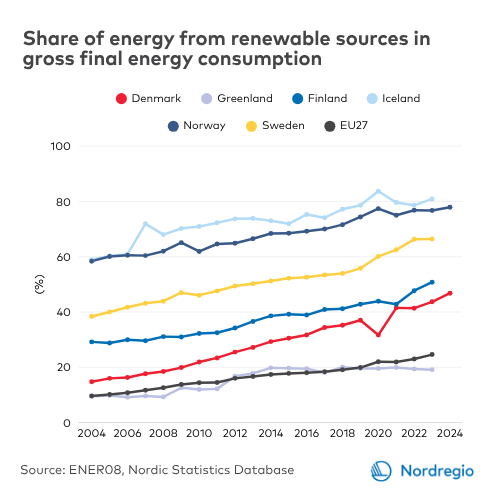
Iceland and Norway have led the region throughout the entire period, drawing heavily on hydropower and geothermal resources built up over decades. Their shares have remained well above any European benchmark throughout, with Norway continuing to climb in the most recent data available.
Sweden and Finland occupy the middle ground, with broadly comparable and steadily rising trajectories over the past twenty years. Finland crossed the 50% threshold for the first time in 2023, a milestone that reflects sustained investment in renewable energy projects.
Denmark tells the most striking story among the large Nordic countries. In 2004, it had one of the lowest renewable share in the region (except for Greenland). By 2024, it had more than tripled that share, a rate of growth unmatched elsewhere in the region and among the fastest recorded in Europe. The transformation is visible in how the country heats its homes, powers its industry, and generates its electricity. Since 2004, Greenland's renewable energy share has remained near 19% , broadly flat while every other Nordic territory has grown significantly over the same period.
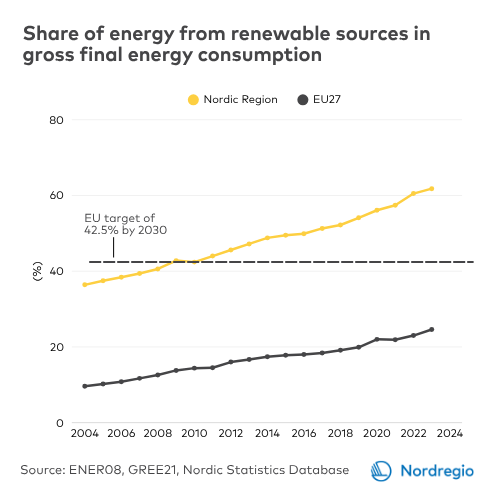
All five large Nordic countries have already exceeded the EU's revised 2030 renewable energy target of 42.5%, set under the Renewable Energy Directive (RED III). The EU average in 2023 remained below 25%, still beneath Denmark's figure from 2018. The gap between the Nordic region and the broader European average is not narrowing. If anything, it is widening.
Progress on the energy share indicator, however, captures how much renewable energy is consumed not how or where the infrastructure producing it is built. As the Nordic region continues to expand wind and other energy projects, questions about land use and the rights of communities affected by that expansion are part of the same transition. The data does not capture this dimension, and the indicator should be read with that in mind.
For those interested in exploring this further, both ENER08 and GREE21 are freely available in the full database.
Renewable energy includes hydropower, geothermal energy, wind energy, and fuels from biomass. The indicator measures the share of renewable sources in gross final energy consumption, excluding conversion losses from electricity and district heating production. For Greenland, data up to 2015 covers only electricity and heat from public supply and is not directly comparable to figures from 2016 onwards, which cover gross final energy consumption. Greenland data is available separately in ENER08 and is not included in the Nordic Region total.
Greenhouse gas emissions in the Nordic region: progress uneven since 1990
On greenhouse gas emissions, the picture is more complicated. The Nordic region has reduced its total territorial emissions by around a third since 1990, but so has the EU as a whole. For a region that does so well with renewable energy, that parallel is worth sitting with.
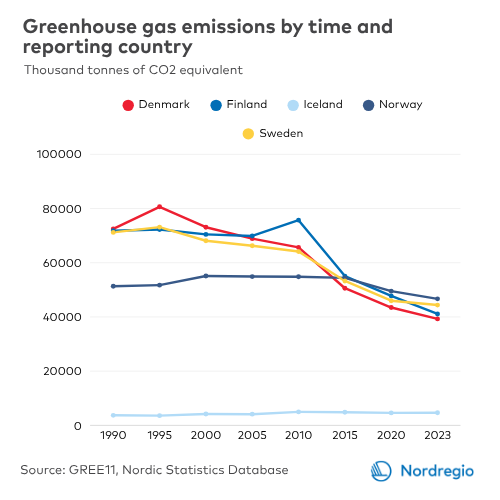
Denmark stands out as the country that has moved furthest and fastest. From the highest peak of any Nordic country in 1996, its emissions have fallen by more than half, a reduction driven by the same energy transition visible in the renewables data, and one that has transformed Denmark's position from the region's largest emitter to its smallest among the large countries.
Sweden and Finland have followed a consistent downward path, each reducing emissions by roughly 40% since 1990. The progress is real and sustained, though neither country is yet on a trajectory to meet the EU's 2030 target of a net 55% reduction from 1990 levels.
Norway's trajectory is the one that invites the most questions. Despite starting from a lower base than Denmark, Finland or Sweden, its emissions have barely shifted, falling by around 9% since 1990, the smallest reduction in the region by a considerable margin.
Iceland's emissions have moved in the opposite direction, rising gradually since 1990. Its contribution to Nordic totals remains small in absolute terms but the direction matters, and the data is there to examine.
The EU's legally binding target under the European Climate Law is a net reduction of at least 55% from 1990 levels by 2030, with full climate neutrality by 2050.
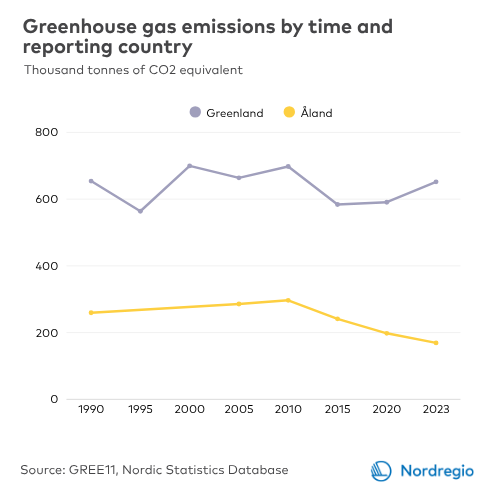
When emissions are viewed per capita, calculated against POPU01 population data, the country rankings shift. Sweden emerges as the strongest performer (emitting the less GHG per capita) by a clear margin, while Norway and Iceland rank among the highest per capita emitters in the region, despite their relatively modest absolute figures.
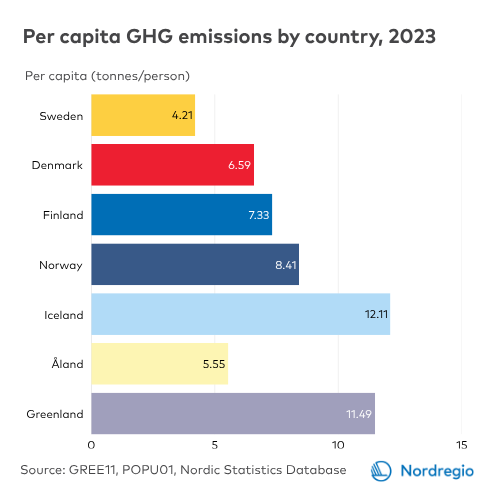
For those interested in exploring this further, both GREE11, and POPU01 are freely available.
Explore Nordic environmental data
These two indicators are a starting point. The Nordic Statistics Database tracks many additional indicators on sustainability, environment or geography for example. The underlying data is downloadable in full. No registration is required.